Buy pernitz.co.at ?
We are moving the project
pernitz.co.at .
Are you interested in purchasing the domain
pernitz.co.at ?
domain@kv-gmbh.de · 0541-91531010
Buy pernitz.co.at ?
What is the iteration rule?
The iteration rule is a mathematical concept that defines how to generate the next term in a sequence or series based on the previous term. It is a formula or set of instructions that allows for the repetition of a process to create a pattern or progression. By following the iteration rule, one can continue to generate new terms in the sequence or series, allowing for the exploration of patterns and relationships within the data. **
What is a general iteration method?
A general iteration method is a mathematical technique used to solve equations or find the roots of a function. It involves repeatedly applying a specific formula or process to an initial guess in order to converge towards the solution. The process is typically iterative, meaning it is repeated until a certain level of accuracy is achieved. General iteration methods are widely used in numerical analysis and computational mathematics to solve a variety of problems. **

Similar search terms for Iteration
Top-Angebote
Products related to Iteration:
-
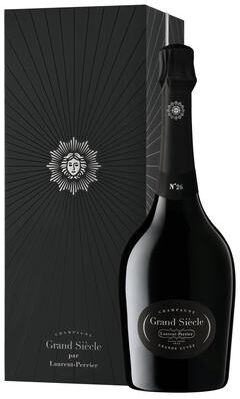
"""Laurent-Perrier Grand Siecle Iteration No. 26 with Gift Box Champagne - France""""""Grand Siècle was born from the vision of Bernard de Nonancourt: to recreate the perfect year, one that nature alone could never deliver. Iteration N°26 embodies this idea, crafted from a masterful blend of three outstanding years – 2012, 2008, and..."279,99 $*Shipping: 0,00 $Secure redirect to the provider
-
"""Laurent-Perrier Grand Siecle Iteration No. 24 (1.5 Liter Magnum) with Gift Box Champagne - France""""""Grand Siècle was born from the vision of Bernard de Nonancourt: to recreate the perfect year, one that nature alone could never deliver. Iteration N°24 embodies this idea, crafted from a masterful blend of three outstanding years – 2007, 2006, and..."679,99 $*Shipping: 0,00 $Secure redirect to the provider
-
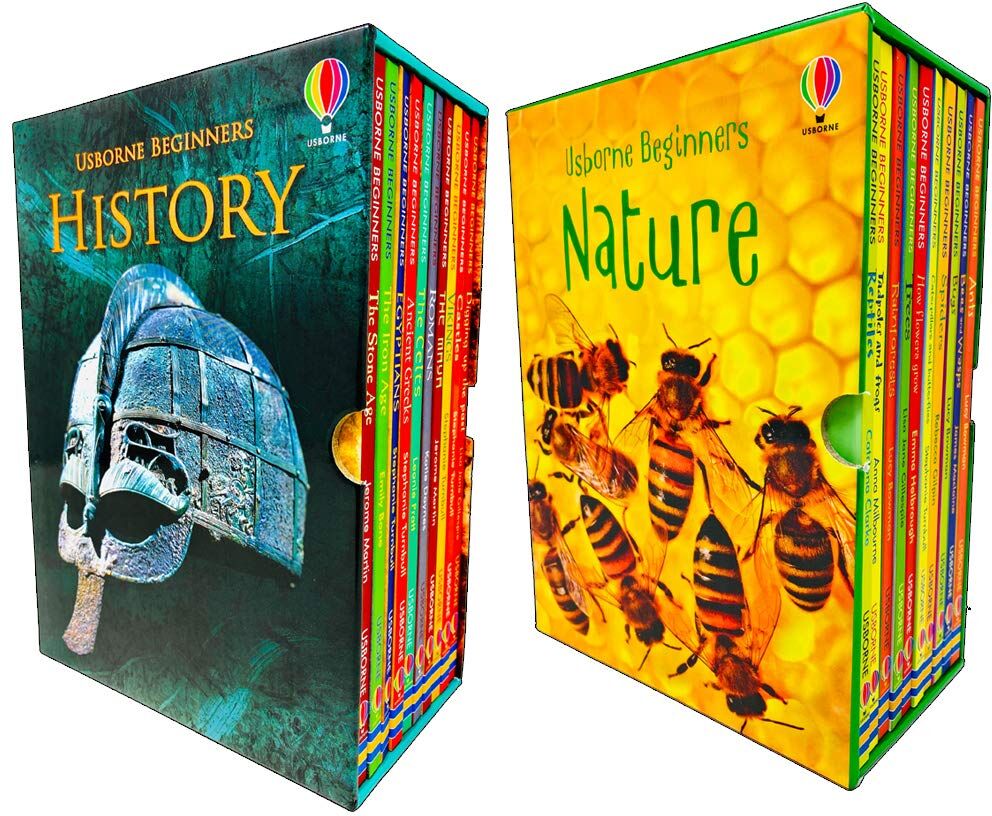
Usborne Publishing Ltd Usborne Beginners History & Usborne Beginners Nature 20 Books Collection Box SetTitles in this set: Usborne Beginners History Stone Age Iron Age Egyptians Ancient Greeks Celts Romans The Maya Vikings Castles Digging Up the Past. Usborne Beginners Nature Reptiles Tadpoles and Frogs Rainforest Trees How Flowers Grow Caterpillars and Butterflies Spiders Bugs Bees & Wasps Ants Description Stone Age This simple information book follows the history of Stone Age people and how they lived. Iron Age This simple information book charts the history of Iron Age people and how they lived, including their farming methods, the gods they prayed to and the hill forts where they lived. Egyptians Who were the ancient Egyptians? Why did they build pyramids and how were mummies made? Ancient Greeks Find out about Ancient Greece, what people wore, ate and did for fun and learn about some of the most famous philosophers and mathematicians of the age in this compelling book for beginner readers. Celts Who were the Celts exactly? Did you know they lived on top of hills? Do you have any idea how Celtic warriors made themselves look really scary in battle? Romans Who were the ancient Romans? Where did they go to eat, shop and wash? What did they do for fun? The Maya Who were the Maya? Where did they live? Why did they build tall stone temples? Vikings Find out what it was like to be a Viking, and learn about Viking homes, feasts, boats, gods and much more in this fascinating book. Castles Who lived in a castle, and what was it like? Children can find out the answers to these questions and lots more about the wonderful world of castles in this informative book. Digging Up the Past How do ancient things get buried? Who digs them up? And what do they find? Beginner readers can find answers to these questions and more in this colourful information book. Reptiles This is a fantastic brand new addition to the "Beginners" series, designed to provide an informative introduction to trees and plant-life for young readers. Tadpoles and Frogs Vivid, full colour illustrations and photographs on every page, accompanied by short, informative text. Rainforest It offers a terrific reading practice for children who prefer fact to fiction. It is developed with a reading expert from Roehampton University to help young readers grow in confidence. Trees This is a fantastic brand new addition to the 'Beginners' series, designed to provide an informative introduction to trees and plant-life for young readers. How Flowers Grow How do flowers grow in dry deserts? How do animals help to spread seeds? Which flower smells like rottng meat? Caterpillars and Butterflies Usborne Beginners are colourful information books for children beginning to read on their own. Spiders Usborne Beginners are colourful information books for children beginning to read on their own. Bugs Usborne Beginners are colourful information books for children beginning to read on their own. Bees & Wasps A slim and unintimidating book which belies its contents - a wealth of information, much of which will be...34,99 £*Shipping: 2,99 £Secure redirect to the provider
-
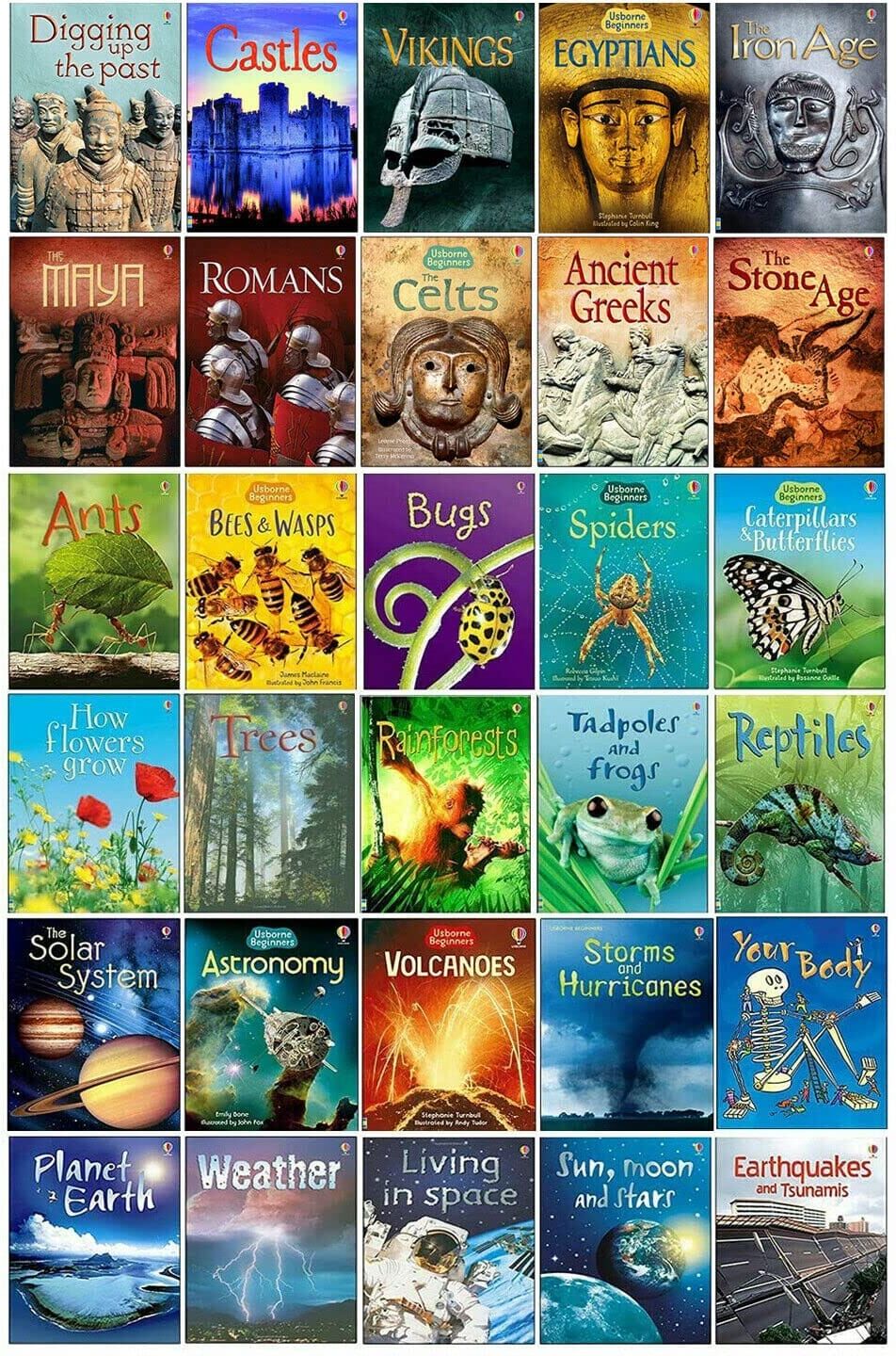
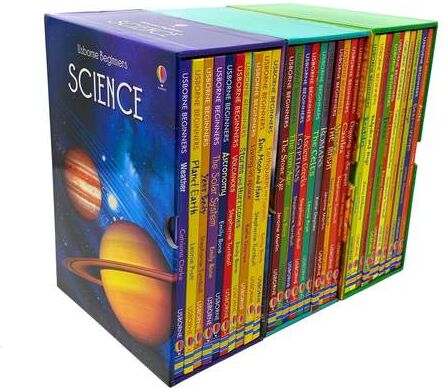
Usborne Beginners Nature, Science & History Collection 30 Books Set - Ages 4-10 - Paperback Usborne Publishing LtdTitles in This Set: Usborne Beginners Nature 10 Books: 1. Ants 2. Bees & Wasps 3. Bugs 4. Spiders 5. Tadpoles and Frogs 6. Caterpillars and Butterflies 7. How Flowers Grow 8. Trees 9. Rainforest 10. Reptiles Usborne Beginners Science 10 Books: 1. Earthquakes & Tsunamis 2. Sun Moon and Stars 3. Living in Space 4. Storms and Hurricanes 5. Volcanoes 6. Astronomy 7. The Solar System 8. Your Body 9. Planet Earth 10. Weather Usborne Beginners History 10 Books: Titles in This Set: 1. Ancient Greeks 2. Castles 3. Celts 4. Digging Up the Past 5. Egyptians 6. Iron Age 7. Maya 8. Romans 9. Stone Age 10. Vikings Description : Usborne Beginners Nature 10 Books Ants Where do ants live? What do they eat? How much weight can they carry? Little children can find out the answers to these questions and much more in this simple introduction to the world of ants. Bees & Wasps What do bees and wasps eat? What type of nests do they make? How do bees make honey? Find out the answers and lots more in this intriguing introduction to the fascinating world of bees and wasps. Bugs ''There are all kinds of different bugs. Some can jump up high. Other bugs have lots of legs.” Bugs is part of an exciting reading series for young children, with lots of pictures and very simple text. Spiders “Spiders have eight legs. Most of them have eight eyes, but some of them can’t see very well.” Learn all about spiders in this great book for children learning to read by themselves. Tadpoles and Frogs From egg to frog, find out about the entire life cycle of a frog in this easy-to-read fully illustrated book for young learners ages 4+. It comes complete with weblinks so you can see the process for yourself. Caterpillars and Butterflies A beautifully illustrated introduction to the life of butterflies and caterpillars, with easy to read text for beginner readers. The life cycle of a butterfly is shown with stunning photographs and illustrations, and there are links to carefully selected websites with videos that show butterflies emerging from their pupae. How Flowers Grow How do flowers grow in dry deserts? How do animals help to spread seeds? Which flower smells like rotting meat? Find out in this great book for young readers ages four and up. Trees How do trees use their leaves to make food? Why do they grow flowers and fruit? Which animals live inside a tree trunk and build nests in its branches? How can we help to protect trees? This book has all the answers and much more, along with photographs, step-by-step illustrations, simple text and links to websites with video clips and activities. Rainforests Learn all about the rainforest in this fantastic easy-to-read book for children 4+ beginning to strike out on their own. From towering trees to rainforest rivers, this fully-illustrated book also features links to carefully selected websites. Reptiles Learn all about the lizard world in this fully-illustrated guide, the latest in the Usborne Beginners series. From scaly skin to tongue tricks...42,75 £*Shipping: 0,00 £Secure redirect to the provider

-
Why does the Picard iteration fail?
The Picard iteration can fail to converge if the fixed-point mapping is not a contraction mapping, meaning that it does not contract the distance between points in the space. This can happen if the mapping has regions of steep slope or if the initial guess is too far from the fixed point. In these cases, the iteration may not converge to the fixed point or may converge very slowly, making it impractical for practical use. Additionally, the Picard iteration may fail if the fixed-point mapping is not continuous or differentiable, as this violates the assumptions required for convergence. **
-
How does the fixed point iteration work?
Fixed point iteration is a method used to find the fixed point of a function, which is a value that does not change when the function is applied to it. The process involves repeatedly applying the function to an initial guess, and using the result as the next guess. This process continues until the difference between consecutive guesses is smaller than a specified tolerance. The fixed point iteration can be used to solve equations of the form x = g(x), where g(x) is a function. **
-
Is the intersection of interval iteration not empty?
No, the intersection of interval iteration is not empty. When two intervals are iterated, they will eventually converge to a common point, which will be the intersection point. This intersection point is not empty and represents the value where the two intervals meet after iteration. **
-
How do you solve the fixed-point iteration method?
To solve the fixed-point iteration method, you first need to rearrange the equation you want to solve into the form \(x = g(x)\), where \(g(x)\) is a function that will help you find the solution. Then, you choose an initial guess for the solution, denoted as \(x_0\). Next, you iterate using the formula \(x_{n+1} = g(x_n)\) until the difference between consecutive approximations is smaller than a specified tolerance level. Finally, the last approximation obtained is the solution to the equation. **
Can someone explain the fixed-point iteration to me?
Sure! Fixed-point iteration is a method used to find the fixed point of a function, which is a point where the function value is equal to the input value. The process involves repeatedly applying the function to an initial guess until the result converges to the fixed point. Mathematically, it can be represented as x_{n+1} = g(x_n), where g(x) is the function being iterated and x_n is the current approximation. Fixed-point iteration is commonly used in numerical analysis to solve equations and find roots of functions. **
How can you delay each iteration of a while loop using BukkitRunnable?
You can delay each iteration of a while loop using BukkitRunnable by scheduling the task to run asynchronously with a delay. Inside the while loop, you can create a new instance of BukkitRunnable and schedule it to run after a certain delay using the `runTaskLater` method. This will allow the while loop to continue iterating, but with a delay between each iteration. It's important to note that using a while loop with delays in BukkitRunnable should be done carefully to avoid performance issues and potential server lag. **
Top-Angebote
Products related to Iteration:
-
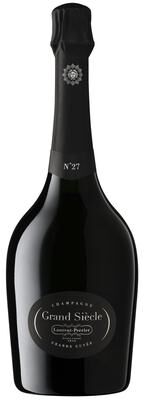
"""Laurent-Perrier Grand Siecle Iteration No. 27 Champagne - France""""""Grand Siècle was born from the vision of Bernard de Nonancourt: to recreate the perfect year, one that nature alone could never deliver. Iteration N°27 embodies this idea, crafted from a masterful blend of three outstanding years – 2015, 2013, and..."269,99 $*Shipping: 0,00 $Secure redirect to the provider
-
Laurent-Perrier Champagne Brut Grande Cuvée 'Grand Siècle Iteration n. 27'The Champagne Brut Grande Cuvée “Grande Siècle Iteration n. 27” is the jewel of Maison Laurent-Perrier, a masterpiece of balance between finesse, power, and freshness, born from selected grapes of prestigious Grands Crus and the best vintages. Its name evokes the golden age of France, the 17th century, as a tribute to the Sun King, to the apotheosis of the arts, to luxury, and to the origins of modern gastronomy.The Champagne “Grande Siècle” Laurent-Perrier has been produced since 1959, and Grand Siècle is born from the vision of Bernard de Nonancourt: to recreate the perfect vintage, one that nature alone can never provide. It starts from a blend of 3 different vintages, contradicting the idea that the most prestigious Cuvées must consist of a single vintage. Its inventor coined the motto “le meilleur du meilleur avec le meilleur,” because it is born from the blend of the best grapes from the best vintages and coming from the best Grand Cru. These are grapes of Chardonnay and Pinot Noir selected from 9 different Grand Crus."Iteration n.27 Grande Siècle” is presented in a sinuous and refined bottle, inspired by the blown glass creations of the glass masters of the 17th century, used for the first Champagnes that arrived on the table of the King of France. After at least 10 years of aging on the lees, the result is a Champagne that is very complex on the nose, combining freshness, energy, and elegance on the palate. Grand Siècle is never tied to a single vintage, but represents a higher concept: the search for absolute balance between intensity, finesse, and harmony. The final result is exciting and surprising: a rich and complex symphony of aromas and enchanting scents, supported by remarkable freshness and very persistent mineral notes, that one would wish would never end.219,00 £*Shipping: 48,00 £Secure redirect to the provider
-
"""Laurent-Perrier Grand Siecle Iteration No. 26 with Gift Box Champagne - France""""""Grand Siècle was born from the vision of Bernard de Nonancourt: to recreate the perfect year, one that nature alone could never deliver. Iteration N°26 embodies this idea, crafted from a masterful blend of three outstanding years – 2012, 2008, and..."279,99 $*Shipping: 0,00 $Secure redirect to the provider
-
"""Laurent-Perrier Grand Siecle Iteration No. 24 (1.5 Liter Magnum) with Gift Box Champagne - France""""""Grand Siècle was born from the vision of Bernard de Nonancourt: to recreate the perfect year, one that nature alone could never deliver. Iteration N°24 embodies this idea, crafted from a masterful blend of three outstanding years – 2007, 2006, and..."679,99 $*Shipping: 0,00 $Secure redirect to the provider
-
What is the iteration rule?
The iteration rule is a mathematical concept that defines how to generate the next term in a sequence or series based on the previous term. It is a formula or set of instructions that allows for the repetition of a process to create a pattern or progression. By following the iteration rule, one can continue to generate new terms in the sequence or series, allowing for the exploration of patterns and relationships within the data. **
-
What is a general iteration method?
A general iteration method is a mathematical technique used to solve equations or find the roots of a function. It involves repeatedly applying a specific formula or process to an initial guess in order to converge towards the solution. The process is typically iterative, meaning it is repeated until a certain level of accuracy is achieved. General iteration methods are widely used in numerical analysis and computational mathematics to solve a variety of problems. **
-
Why does the Picard iteration fail?
The Picard iteration can fail to converge if the fixed-point mapping is not a contraction mapping, meaning that it does not contract the distance between points in the space. This can happen if the mapping has regions of steep slope or if the initial guess is too far from the fixed point. In these cases, the iteration may not converge to the fixed point or may converge very slowly, making it impractical for practical use. Additionally, the Picard iteration may fail if the fixed-point mapping is not continuous or differentiable, as this violates the assumptions required for convergence. **
-
How does the fixed point iteration work?
Fixed point iteration is a method used to find the fixed point of a function, which is a value that does not change when the function is applied to it. The process involves repeatedly applying the function to an initial guess, and using the result as the next guess. This process continues until the difference between consecutive guesses is smaller than a specified tolerance. The fixed point iteration can be used to solve equations of the form x = g(x), where g(x) is a function. **
Similar search terms for Iteration
-
Usborne Publishing Ltd Usborne Beginners History & Usborne Beginners Nature 20 Books Collection Box SetTitles in this set: Usborne Beginners History Stone Age Iron Age Egyptians Ancient Greeks Celts Romans The Maya Vikings Castles Digging Up the Past. Usborne Beginners Nature Reptiles Tadpoles and Frogs Rainforest Trees How Flowers Grow Caterpillars and Butterflies Spiders Bugs Bees & Wasps Ants Description Stone Age This simple information book follows the history of Stone Age people and how they lived. Iron Age This simple information book charts the history of Iron Age people and how they lived, including their farming methods, the gods they prayed to and the hill forts where they lived. Egyptians Who were the ancient Egyptians? Why did they build pyramids and how were mummies made? Ancient Greeks Find out about Ancient Greece, what people wore, ate and did for fun and learn about some of the most famous philosophers and mathematicians of the age in this compelling book for beginner readers. Celts Who were the Celts exactly? Did you know they lived on top of hills? Do you have any idea how Celtic warriors made themselves look really scary in battle? Romans Who were the ancient Romans? Where did they go to eat, shop and wash? What did they do for fun? The Maya Who were the Maya? Where did they live? Why did they build tall stone temples? Vikings Find out what it was like to be a Viking, and learn about Viking homes, feasts, boats, gods and much more in this fascinating book. Castles Who lived in a castle, and what was it like? Children can find out the answers to these questions and lots more about the wonderful world of castles in this informative book. Digging Up the Past How do ancient things get buried? Who digs them up? And what do they find? Beginner readers can find answers to these questions and more in this colourful information book. Reptiles This is a fantastic brand new addition to the "Beginners" series, designed to provide an informative introduction to trees and plant-life for young readers. Tadpoles and Frogs Vivid, full colour illustrations and photographs on every page, accompanied by short, informative text. Rainforest It offers a terrific reading practice for children who prefer fact to fiction. It is developed with a reading expert from Roehampton University to help young readers grow in confidence. Trees This is a fantastic brand new addition to the 'Beginners' series, designed to provide an informative introduction to trees and plant-life for young readers. How Flowers Grow How do flowers grow in dry deserts? How do animals help to spread seeds? Which flower smells like rottng meat? Caterpillars and Butterflies Usborne Beginners are colourful information books for children beginning to read on their own. Spiders Usborne Beginners are colourful information books for children beginning to read on their own. Bugs Usborne Beginners are colourful information books for children beginning to read on their own. Bees & Wasps A slim and unintimidating book which belies its contents - a wealth of information, much of which will be...34,99 £*Shipping: 2,99 £Secure redirect to the provider
-
Usborne Beginners Nature, Science & History Collection 30 Books Set - Ages 4-10 - Paperback Usborne Publishing LtdTitles in This Set: Usborne Beginners Nature 10 Books: 1. Ants 2. Bees & Wasps 3. Bugs 4. Spiders 5. Tadpoles and Frogs 6. Caterpillars and Butterflies 7. How Flowers Grow 8. Trees 9. Rainforest 10. Reptiles Usborne Beginners Science 10 Books: 1. Earthquakes & Tsunamis 2. Sun Moon and Stars 3. Living in Space 4. Storms and Hurricanes 5. Volcanoes 6. Astronomy 7. The Solar System 8. Your Body 9. Planet Earth 10. Weather Usborne Beginners History 10 Books: Titles in This Set: 1. Ancient Greeks 2. Castles 3. Celts 4. Digging Up the Past 5. Egyptians 6. Iron Age 7. Maya 8. Romans 9. Stone Age 10. Vikings Description : Usborne Beginners Nature 10 Books Ants Where do ants live? What do they eat? How much weight can they carry? Little children can find out the answers to these questions and much more in this simple introduction to the world of ants. Bees & Wasps What do bees and wasps eat? What type of nests do they make? How do bees make honey? Find out the answers and lots more in this intriguing introduction to the fascinating world of bees and wasps. Bugs ''There are all kinds of different bugs. Some can jump up high. Other bugs have lots of legs.” Bugs is part of an exciting reading series for young children, with lots of pictures and very simple text. Spiders “Spiders have eight legs. Most of them have eight eyes, but some of them can’t see very well.” Learn all about spiders in this great book for children learning to read by themselves. Tadpoles and Frogs From egg to frog, find out about the entire life cycle of a frog in this easy-to-read fully illustrated book for young learners ages 4+. It comes complete with weblinks so you can see the process for yourself. Caterpillars and Butterflies A beautifully illustrated introduction to the life of butterflies and caterpillars, with easy to read text for beginner readers. The life cycle of a butterfly is shown with stunning photographs and illustrations, and there are links to carefully selected websites with videos that show butterflies emerging from their pupae. How Flowers Grow How do flowers grow in dry deserts? How do animals help to spread seeds? Which flower smells like rotting meat? Find out in this great book for young readers ages four and up. Trees How do trees use their leaves to make food? Why do they grow flowers and fruit? Which animals live inside a tree trunk and build nests in its branches? How can we help to protect trees? This book has all the answers and much more, along with photographs, step-by-step illustrations, simple text and links to websites with video clips and activities. Rainforests Learn all about the rainforest in this fantastic easy-to-read book for children 4+ beginning to strike out on their own. From towering trees to rainforest rivers, this fully-illustrated book also features links to carefully selected websites. Reptiles Learn all about the lizard world in this fully-illustrated guide, the latest in the Usborne Beginners series. From scaly skin to tongue tricks...42,75 £*Shipping: 0,00 £Secure redirect to the provider
-
Usborne Beginners Series – 30 Book Collection Box Set Children’s Educational Books (History, Nature & Science) KS1 KS2Usborne Beginners Series 30 Books Collection Box Set (History- Nature- Science) Build a strong foundation in knowledge and reading with the Usborne Beginners Series – 30 Books Collection Box Set, published by Usborne. This comprehensive educational collection introduces children to a wide range of topics across history, science, and nature, using clear language, engaging illustrations, and structured layouts designed for young learners. Perfectly suited for KS1 and KS2 pupils, these books support both curriculum learning and independent reading. From natural disasters and wildlife to historical events and scientific discoveries, the series encourages curiosity, critical thinking, and a love of learning. Description Titles in this set: History Stone Age Iron Age Egyptians Ancient Greeks Celts Romans The Maya Vikings Castles Digging Up the Past Nature Reptiles Tadpoles and Frogs Rainforest Trees How Flowers Grow Caterpillars and Butterflies Spiders Bugs Bees & Wasps Ants Science Earthquakes & Tsunamis Sun Moon and Stars Living in Space Storms and Hurricanes Volcanoes Astronomy The Solar System Your Body Planet Earth Weather Related Tags: Usborne, Usbourne42,75 £*Shipping: 0,00 £Secure redirect to the provider
-
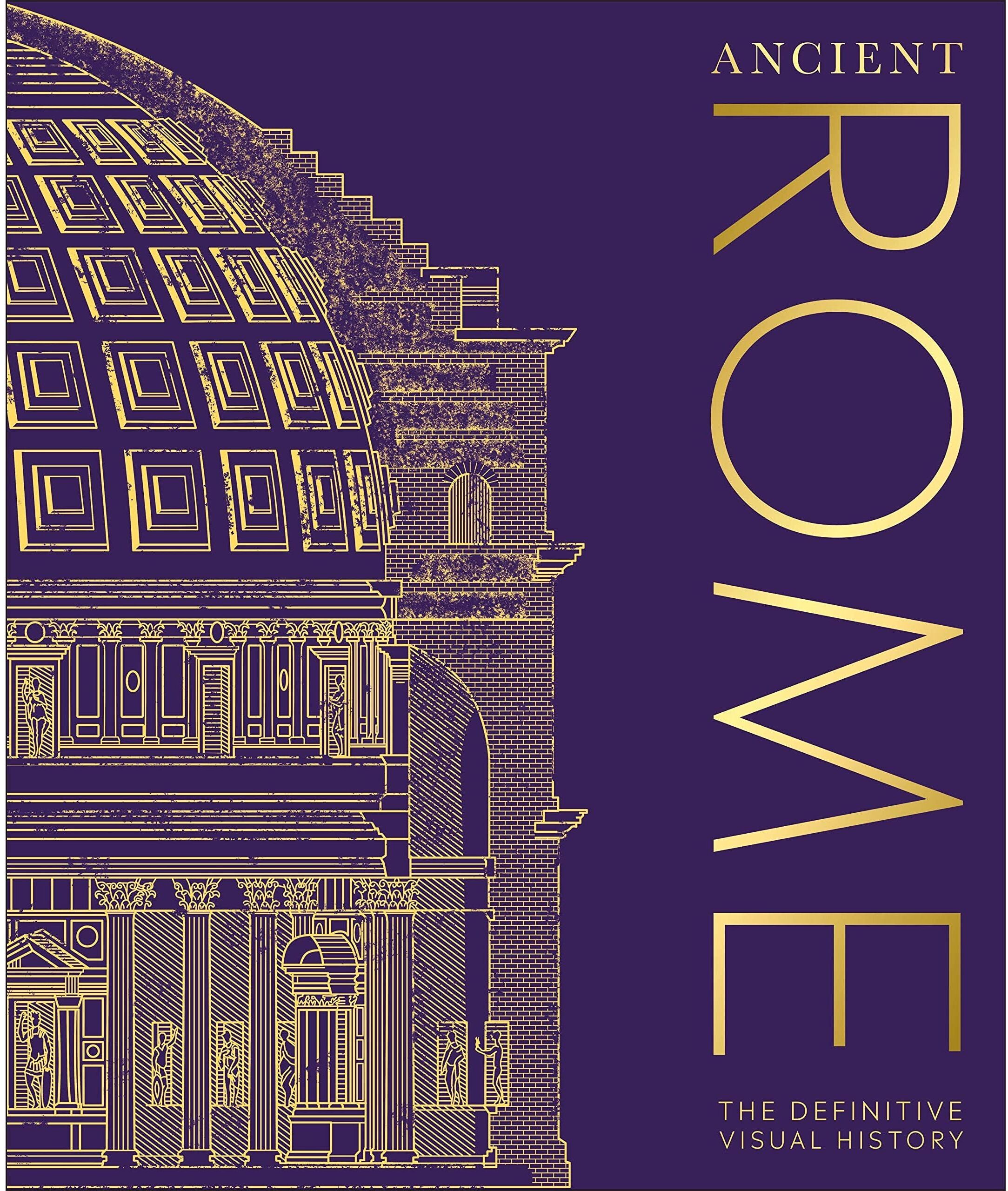
Ancient Rome: The Definitive Visual History (DK Classic History)Immerse yourself in the history of ancient Rome - from its origins as a small settlement on the Palatine Hill to its peak as an empire reigning over 90 million people, and its tumultuous decline. Covering more than 1,000 years of history, and an empire that stretched from Scotland to Syria, Ancient Rome reveals in vivid detail all of the key political, cultural, and military events that shaped the Roman Empire and explores what it was like to live in a society that laid the foundations for many aspects of the modern world. Sumptuous photography and engaging text cover every facet of life in ancient Rome, from art, entertainment, and fashion to engineering, medicine, and war, while detailed maps trace the rise of the mighty Roman Empire. Step back in time in the pages of this history book to discover:- Themed spreads explore developments in areas such as sculpture, religion, warfare, and engineering. - Includes tales of the most dramatic events and battles in Roman history, as well as profiles of influential historical and cultural figures. - An optional 80pp reference section includes sections on rulers, gods and goddesses, and key sites. Featuring Rome's greatest emperors, from Augustus to Constantine, as well as profiles of generals, historians, and influential women, Ancient Rome also delves into the fascinating stories of gladiators, bakers, and enslaved people. The most iconic buildings of Rome are brought to life with specially commissioned CGI recreations, while the stories of ordinary citizens, soldiers, and persecuted groups from across the empire are told with the help of illustrations, artefacts, and eyewitness accounts. Beautifully illustrated and unparalleled in scope, Ancient Rome is the perfect book for anyone who is interested in this defining period of world history.19,95 £*Shipping: 2,99 £Secure redirect to the provider
-
Is the intersection of interval iteration not empty?
No, the intersection of interval iteration is not empty. When two intervals are iterated, they will eventually converge to a common point, which will be the intersection point. This intersection point is not empty and represents the value where the two intervals meet after iteration. **
-
How do you solve the fixed-point iteration method?
To solve the fixed-point iteration method, you first need to rearrange the equation you want to solve into the form \(x = g(x)\), where \(g(x)\) is a function that will help you find the solution. Then, you choose an initial guess for the solution, denoted as \(x_0\). Next, you iterate using the formula \(x_{n+1} = g(x_n)\) until the difference between consecutive approximations is smaller than a specified tolerance level. Finally, the last approximation obtained is the solution to the equation. **
-
Can someone explain the fixed-point iteration to me?
Sure! Fixed-point iteration is a method used to find the fixed point of a function, which is a point where the function value is equal to the input value. The process involves repeatedly applying the function to an initial guess until the result converges to the fixed point. Mathematically, it can be represented as x_{n+1} = g(x_n), where g(x) is the function being iterated and x_n is the current approximation. Fixed-point iteration is commonly used in numerical analysis to solve equations and find roots of functions. **
-
How can you delay each iteration of a while loop using BukkitRunnable?
You can delay each iteration of a while loop using BukkitRunnable by scheduling the task to run asynchronously with a delay. Inside the while loop, you can create a new instance of BukkitRunnable and schedule it to run after a certain delay using the `runTaskLater` method. This will allow the while loop to continue iterating, but with a delay between each iteration. It's important to note that using a while loop with delays in BukkitRunnable should be done carefully to avoid performance issues and potential server lag. **
* All prices are inclusive of VAT and, if applicable, plus shipping costs. The offer information is based on the details provided by the respective shop and is updated through automated processes. Real-time updates do not occur, so deviations can occur in individual cases. ** Note: Parts of this content were created by AI.